J. F. Backman, the pioneer behind Sweden’s first safe factory
Johan Fredrik Ludvig Backman, 1830–1896, was the smith and manufacturer who founded Sweden’s first safe factory in 1854. Through technical development, public fire tests and independent certification, he became an important pioneer of the documented fire protection that would much later develop into today’s standardised fire rating of safes and document cabinets.
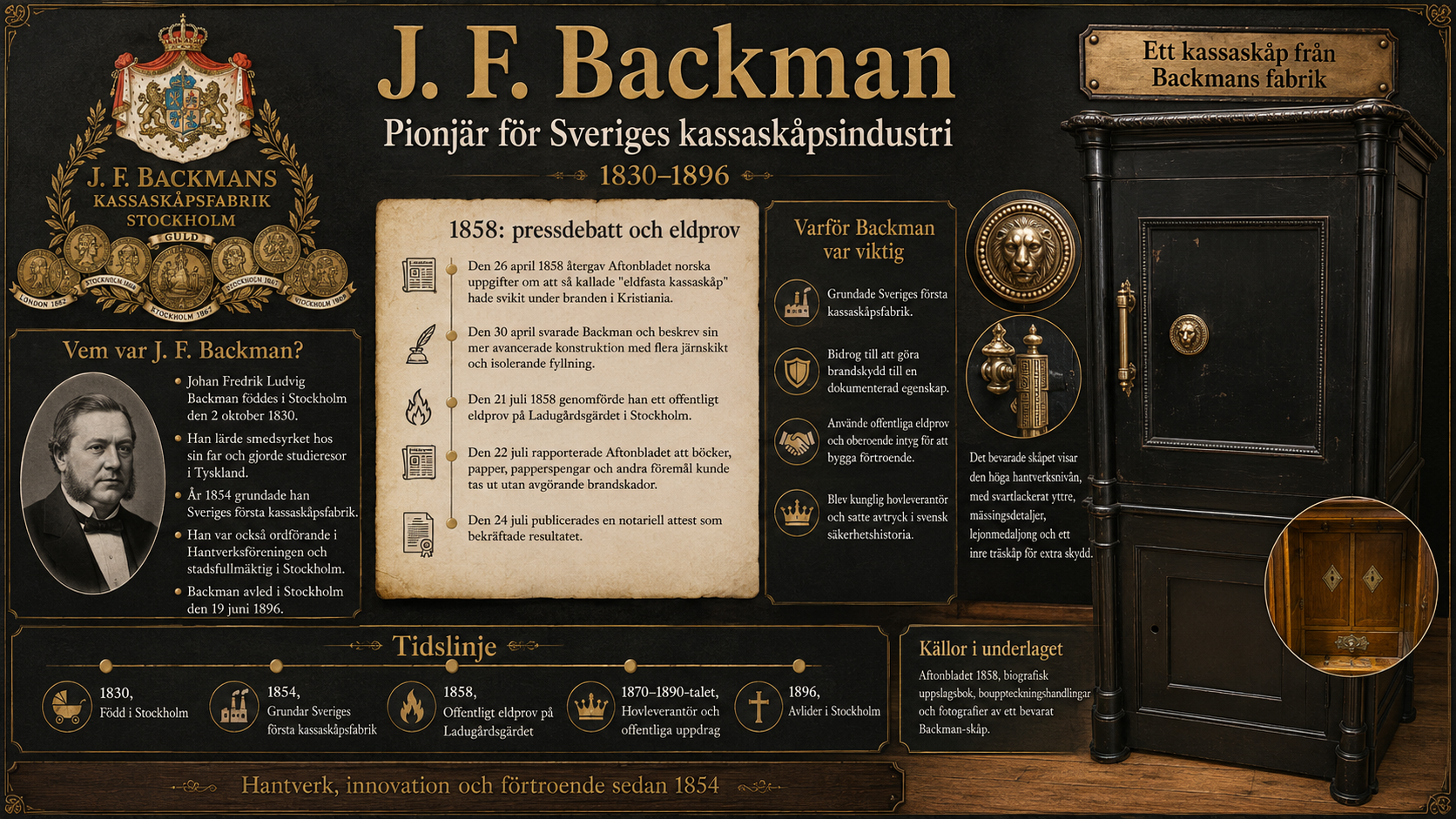 J. F. Backman founded Sweden’s first safe factory in 1854 and became an early pioneer of documented fire protection for safes. The infographic has been compiled from the historical source material presented in this article. Click the image to view it at full size.
From smith’s apprentice to Swedish safe industry pioneer
Johan Fredrik Ludvig Backman was born in Stockholm on 2 October 1830. According to the biographical documentation, he learned the smith’s trade from his father and later continued his professional training through study trips to Germany. In 1854 he took a step that would prove highly significant for the Swedish security industry, establishing what the biographical source describes as Sweden’s first safe factory.
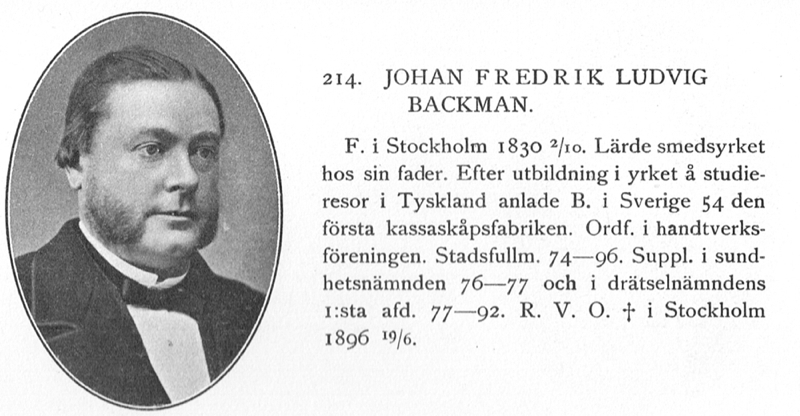 Johan Fredrik Ludvig Backman, 1830–1896. The biographical reference states that he established Sweden’s first safe factory in 1854. Image source: Svenskt Porträttarkiv, the Swedish Portrait Archive.
Backman worked at a time when fire-resistant storage had not yet acquired the standardised test methods and fire classifications that we are familiar with today. Terms equivalent to "fireproof safe" were used, but there was no modern system in which safes were tested according to precisely defined temperature curves and classified for, for example, 60, 90 or 120 minutes of fire protection.
This made the question of what a supposedly "fireproof" safe could actually withstand highly relevant. Backman’s response to this challenge was remarkably modern. He publicly described his construction methods, subjected his products to practical fire tests in front of witnesses and had the results documented by an independent notary public.
The fire in Christiania sparked a Swedish debate
On 26 April 1858, Aftonbladet published a short report based on information from Norwegian newspapers. It stated that so-called "fireproof safes" had proved unreliable during a major fire in Christiania, now Oslo. Papers stored in some of the safes were reported to have been burnt and to have fallen apart when touched.
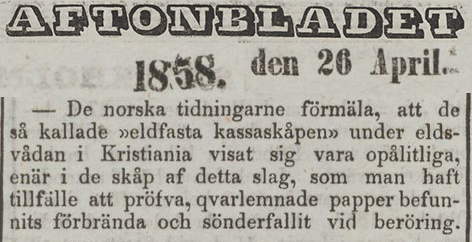 Aftonbladet, 26 April 1858. Reports from Norway raised questions about how reliable the supposedly fireproof safes of the period really were. Digitised newspaper clipping retrieved from the National Library of Sweden’s Swedish Newspapers archive.
Backman responded quickly. His reply was published in Aftonbladet as early as 30 April. He did not dispute that poorly constructed safes could fail, but emphasised that there were major differences between different types of construction.
Backman’s construction, iron, ash and chalk
In his response, Backman described how his own safes were built. According to him, the walls and doors consisted of several separate sheets of iron. Between the layers of iron was a thick insulating layer of ash and finely ground chalk. Backman argued that, based on the experience of the time, this mixture provided better insulation against heat than cork, which was also used as an insulating material.
He stated that his safes had already undergone fire tests, but he did not simply rely on earlier certificates. In the same published response, he promised to manufacture a new safe and conduct a public experiment during the summer in which the construction would be exposed to an intense fire.
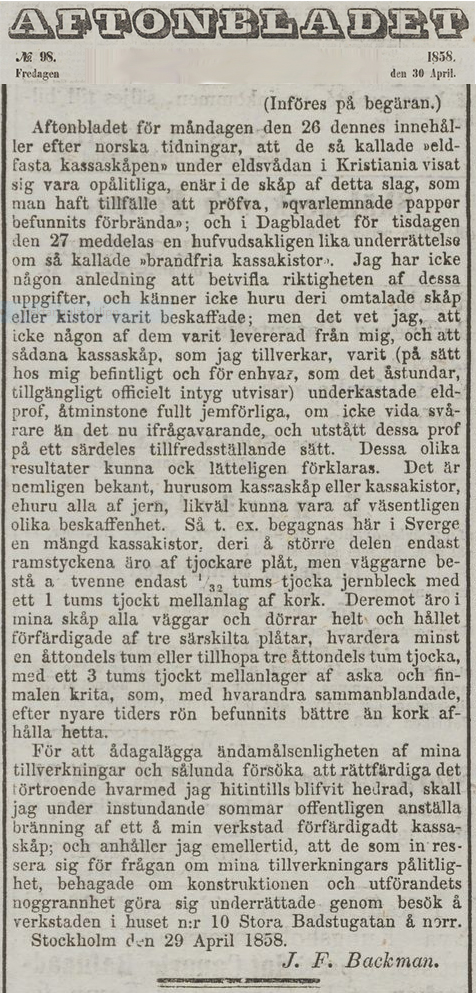 In his response of 30 April 1858, Backman described the multi-layer construction of his safes and at the same time promised to conduct a new public fire test. Digitised newspaper clipping retrieved from the National Library of Sweden’s Swedish Newspapers archive.
The fire test at Ladugårdsgärdet on 21 July 1858
Backman kept his promise. On 20 July, he announced in Aftonbladet that the promised "Eldprofvet med Kassaskåp", or "Fire Test with a Safe", would take place the following afternoon at Ladugårdsgärdet in Stockholm. The public was explicitly invited to witness the experiment.
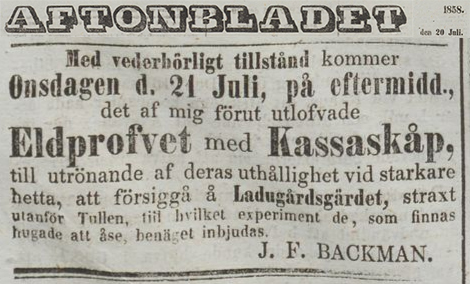 Backman’s announcement of the public fire test at Ladugårdsgärdet on 21 July 1858. Digitised newspaper clipping retrieved from the National Library of Sweden’s Swedish Newspapers archive.
The following day, Aftonbladet reported that a large number of spectators had gathered. The safe was placed on masonry stone pillars and surrounded by a large quantity of spruce firewood. At around three o’clock in the afternoon, the wood was set alight. The fire quickly intensified and the flames engulfed the safe.
According to the newspaper report, the wood had burnt down by around six o’clock, while the safe itself remained glowing on the pillars. It was not until around seven o’clock that it was cooled with water from a fire engine.
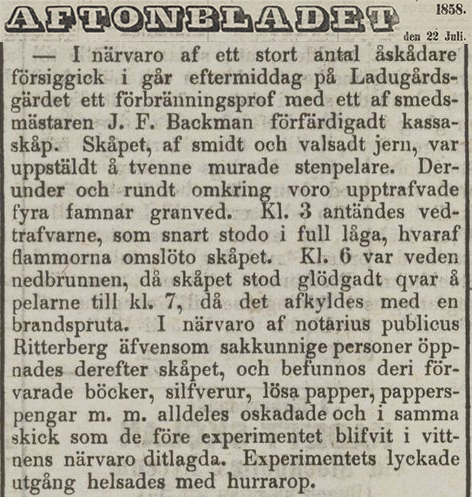 Aftonbladet’s report from the fire test. The safe had been exposed to several hours of intense fire before being cooled and opened. Digitised newspaper clipping retrieved from the National Library of Sweden’s Swedish Newspapers archive.
Books, papers and banknotes survived the test
When the safe was subsequently opened, this was done in the presence of, among others, notary public Johan Henrik Ritterberg. Before the fire, books, loose papers, banknotes, a silver watch and other objects had been placed inside the safe.
Aftonbladet’s initial report described the contents as undamaged. The more detailed notarial certificate, published on 24 July, provides a somewhat more nuanced but still impressive account. The objects were warm and damp after the test, but the paper, book bindings, writing and seals were otherwise reported to be undamaged and unchanged.
For Backman, this was more than a spectacular demonstration. He had produced public and documented evidence that the fire resistance of a safe could be tested in practice. The fact that the experiment was witnessed by a notary public and a large number of other people gave the result a level of credibility that advertising alone could never have achieved.
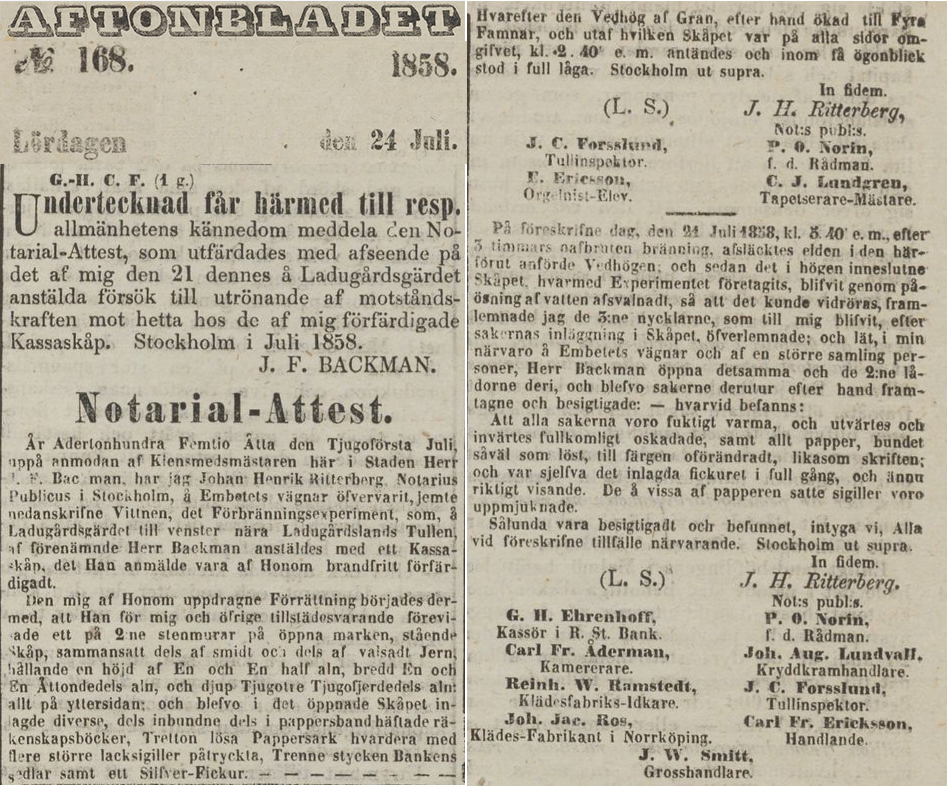 The notarial certificate from the fire test was published in Aftonbladet on 24 July 1858 and gave a detailed account of how the test had been conducted and of its result. Digitised newspaper clipping retrieved from the National Library of Sweden’s Swedish Newspapers archive.
A predecessor of today’s documented fire protection
It would be historically incorrect to describe Backman’s safes of 1858 as "fire rated" in the modern technical sense. Modern fire classifications are based on standardised testing procedures in which factors such as temperature, duration and the maximum permitted temperature inside the safe are precisely defined.
Backman’s approach, however, clearly pointed in the same direction. He combined a specially developed construction with practical testing, public scrutiny and documentation by an independent party. His fire test therefore represents an early step in the development from general claims about "fireproof" safes towards more verifiable and documented fire protection.
This is precisely what makes Backman particularly interesting from a modern perspective. The fundamental principle remains the same today, fire protection should not merely be claimed to work, it should be demonstrated through testing.
Manufacturer, civic figure and Purveyor to the Royal Court
Backman’s business grew, and over time he gained a prominent position beyond his own factory. The biographical reference states that he was chairman of the Crafts Association and a member of Stockholm City Council from 1874 to 1896. He also served as a deputy member of the Board of Health in 1876–1877 and of the first division of the municipal Finance Board from 1877 to 1892.
He was also made a Knight of the Order of Vasa. The surviving factory emblem furthermore shows that J. F. Backman’s safe factory was a Purveyor to the Royal Court. Together with the medals and awards depicted on the emblem, this illustrates how the company highlighted both official recognition and its successes at exhibitions of the period.
The Backman family and the safe factory
Safe manufacturing formed part of a longer tradition of skilled metalworking within the Backman family. Johan Fredrik Ludvig Backman’s father, Fredrik Backman, 1802–1861, was, like his son, a master smith. He purchased the property at Badstugatan 10 in Norrmalm, Stockholm, the property that later became associated with the family’s business and J. F. Backman’s safe factory. Johan Fredrik Ludvig therefore grew up with the smith’s trade close at hand and, according to the biographical source, learned the profession from his father before continuing his training and founding Sweden’s first safe factory in 1854.
The next generation also continued the business. His son Karl Fredrik (Fritz) Ferdinand Backman, born in 1857, became a factory proprietor and proprietor of J. F. Backman’s safe factory. His younger brother John Fredrik Magnus Backman, 1862–1936, worked as a manufacturer and ironmonger. He became an authorised signatory at his father’s safe factory and took over the company in 1912. The history of the business therefore spans several generations of the Backman family, from Fredrik Backman’s smithing, through J. F. Backman’s pioneering work in Swedish safe manufacturing, to the continued involvement of his sons.
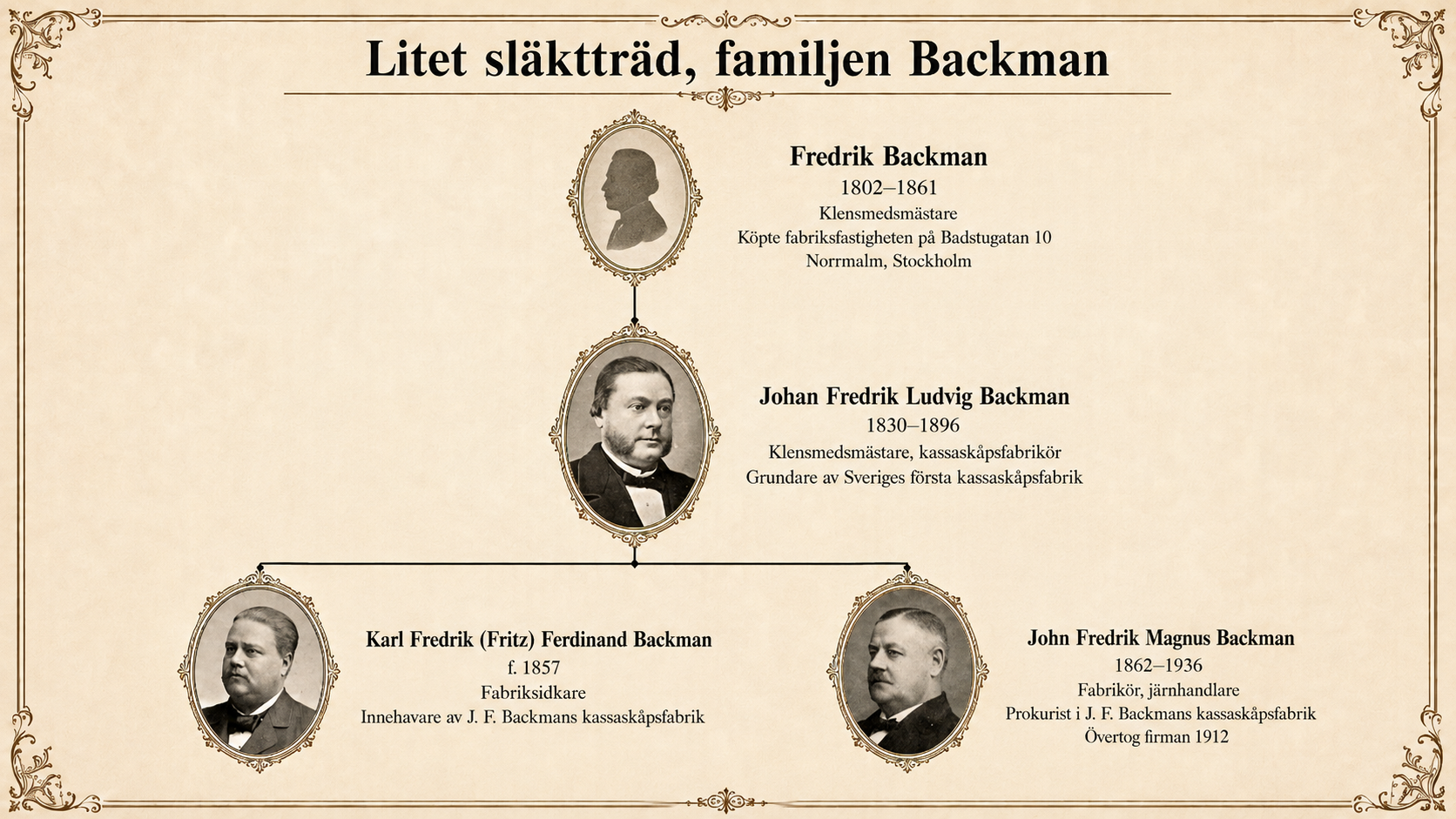 Three generations of the Backman family associated with smithing and the safe factory. At the top is Fredrik Backman, 1802–1861, followed by Johan Fredrik Ludvig Backman, 1830–1896, and his sons Karl Fredrik (Fritz) Ferdinand Backman and John Fredrik Magnus Backman. Click the image to open the family tree at full size.
Backman’s safe factory is incorporated into J. Isaksson & Co
The Backman family’s period as independent safe manufacturers eventually came to an end. In the contemporary company history Näringslivets utveckling i Sverige under åren 1859–1929, it is stated that J. Isaksson & Co was converted into a limited company in 1925 and that J. F. Backman’s Safe Factory was subsequently incorporated into the company. The wording is explicit: by the time the publication appeared in 1929, Backman’s firm had “now been incorporated” into A.-B. J. Isaksson & Co Kassaskåpsfabrik. Two of Stockholm’s oldest and most established safe businesses had thereby been brought together under the same company.
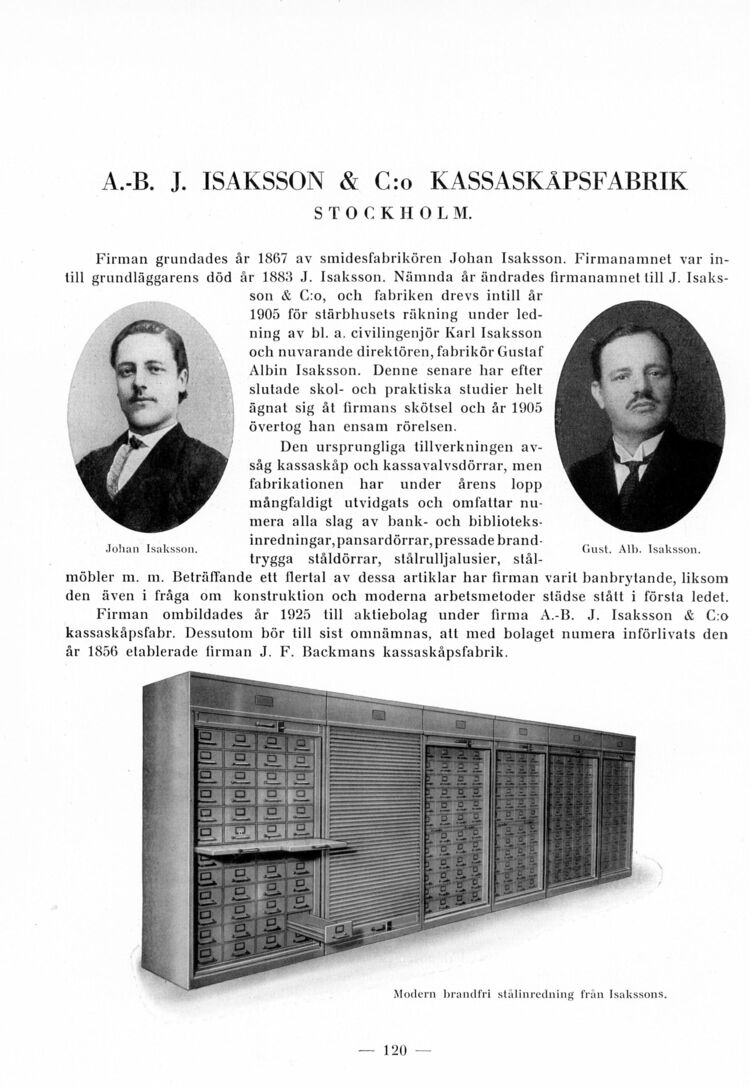 A company history published in 1929 explicitly states that J. F. Backman’s Safe Factory had been incorporated into A.-B. J. Isaksson & Co Kassaskåpsfabrik. Click the image to open the source at a larger size.
The well-known Backman name did not disappear immediately after the incorporation. Stockholm address and telephone directories show that J. F. Backman’s Safe Factory and J. Isaksson & Co continued to appear in parallel for many years. In the 1948 edition of Röda boken, both businesses are listed at Ekbacksvägen 14 in Ulvsunda and with the same telephone number, 25 65 00. This clearly shows that the Backman name continued to be used within Isaksson’s organisation even after the independent firm had been absorbed into the company. During the 1950s, the name Pansar-Isaksson instead appears alongside J. Isaksson & Co. Directory material from 1955, 1956 and 1961 documents the continued operation, while the 1962 directory describes Pansar-Isaksson as a business specialising in the repair and servicing of locks, safes and vaults. Together, these sources make it possible to trace how the legacy of Backman’s safe factory continued within J. Isaksson & Co long after the era of the Backman family business.
A surviving safe from J. F. Backman’s factory
A surviving safe from J. F. Backman’s factory demonstrates that these security products were not merely functional technical objects. They were also elaborate pieces of furniture and status symbols. The photographed example has a substantial black exterior, profiled corner pillars, decorative mouldings and metal fittings.
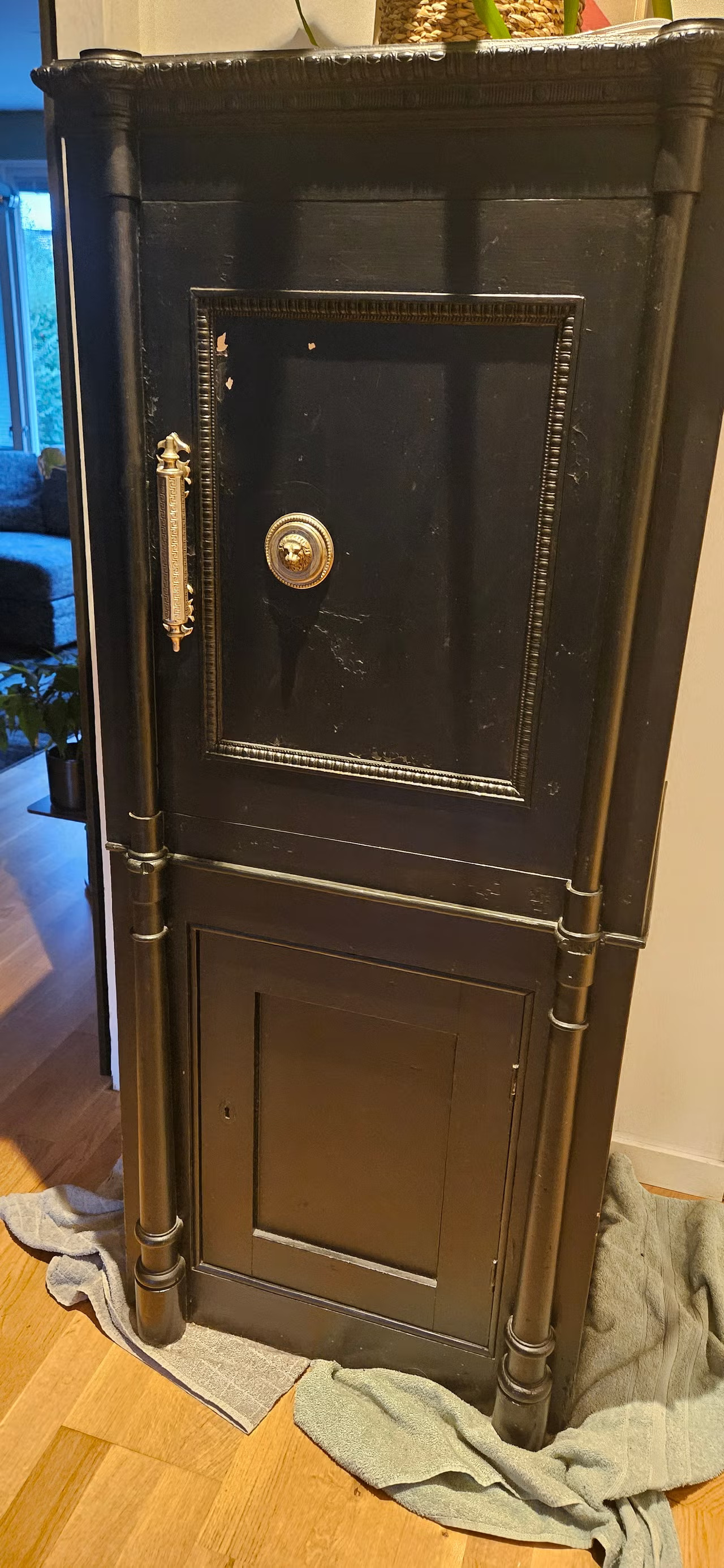 A surviving safe from J. F. Backman’s factory in Stockholm. Click the image to open the original in a new tab. Photograph from a sales listing on Blocket.
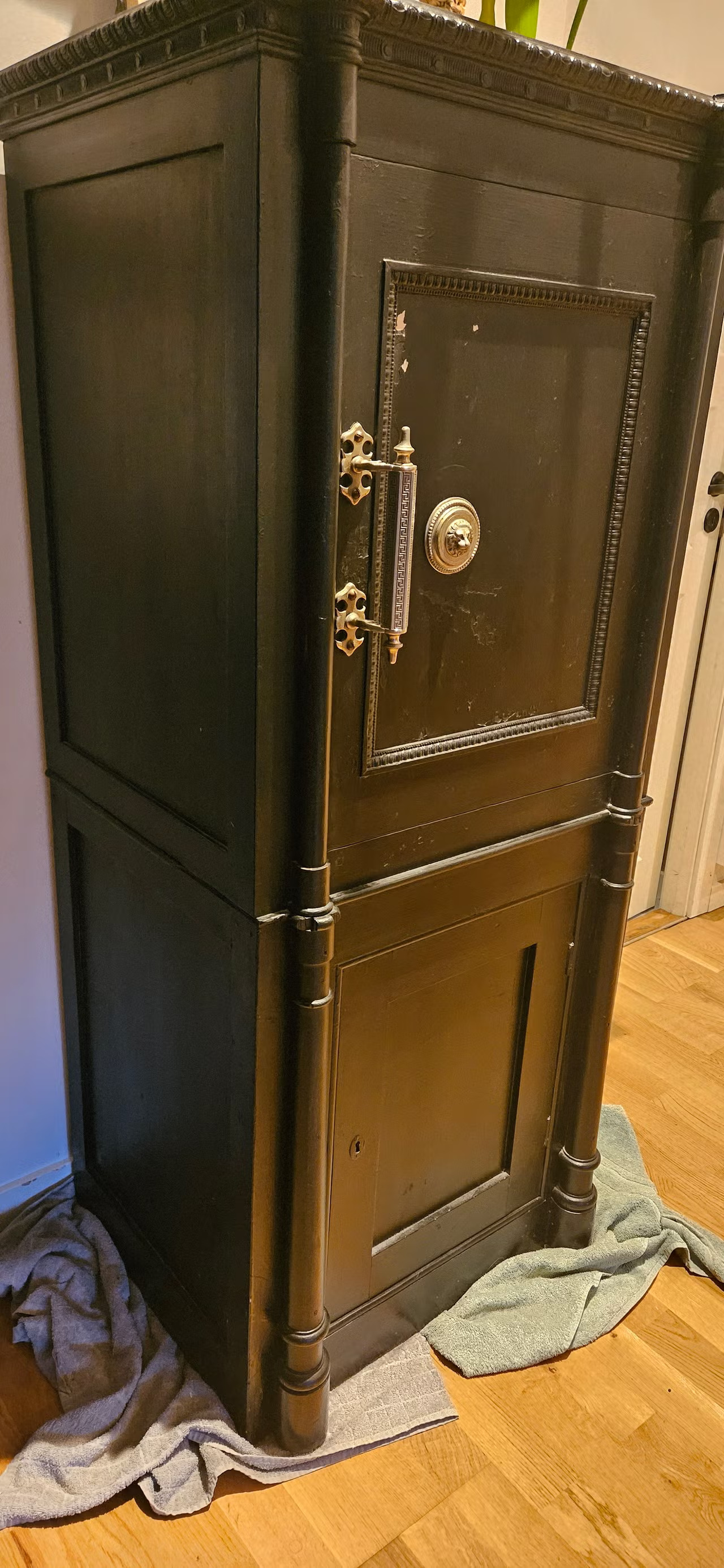 The tall, furniture-like construction shows how a safe could be designed as an elaborate feature of a nineteenth-century interior. Click the image to view it at a larger size. Photograph from a sales listing on Blocket.
The main door features a circular medallion with a lion’s head. Beside it is an ornately decorated handle with a geometric meander pattern. These details demonstrate the high level of craftsmanship applied even to the mechanical and functional components.
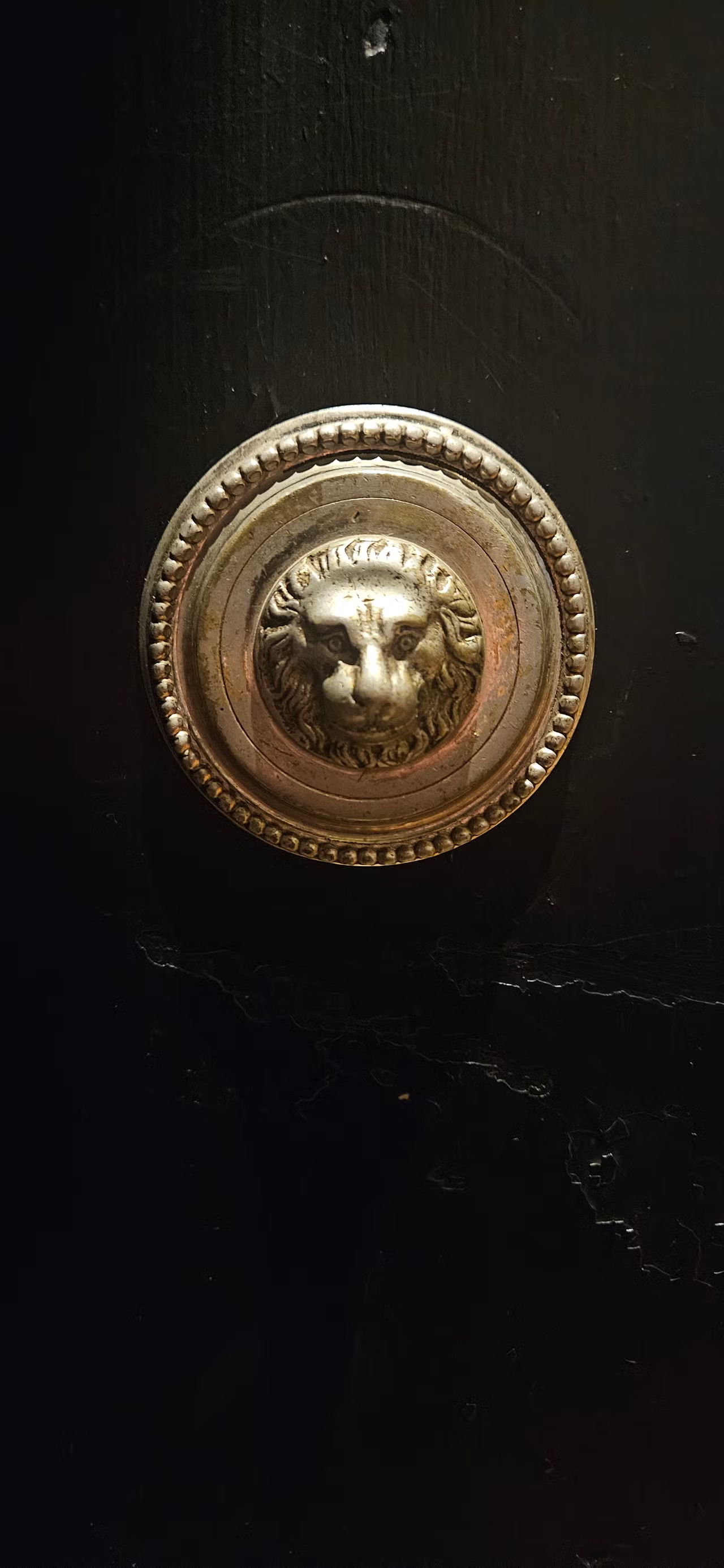 The decorative lion medallion on the safe door. Photograph from a sales listing on Blocket.
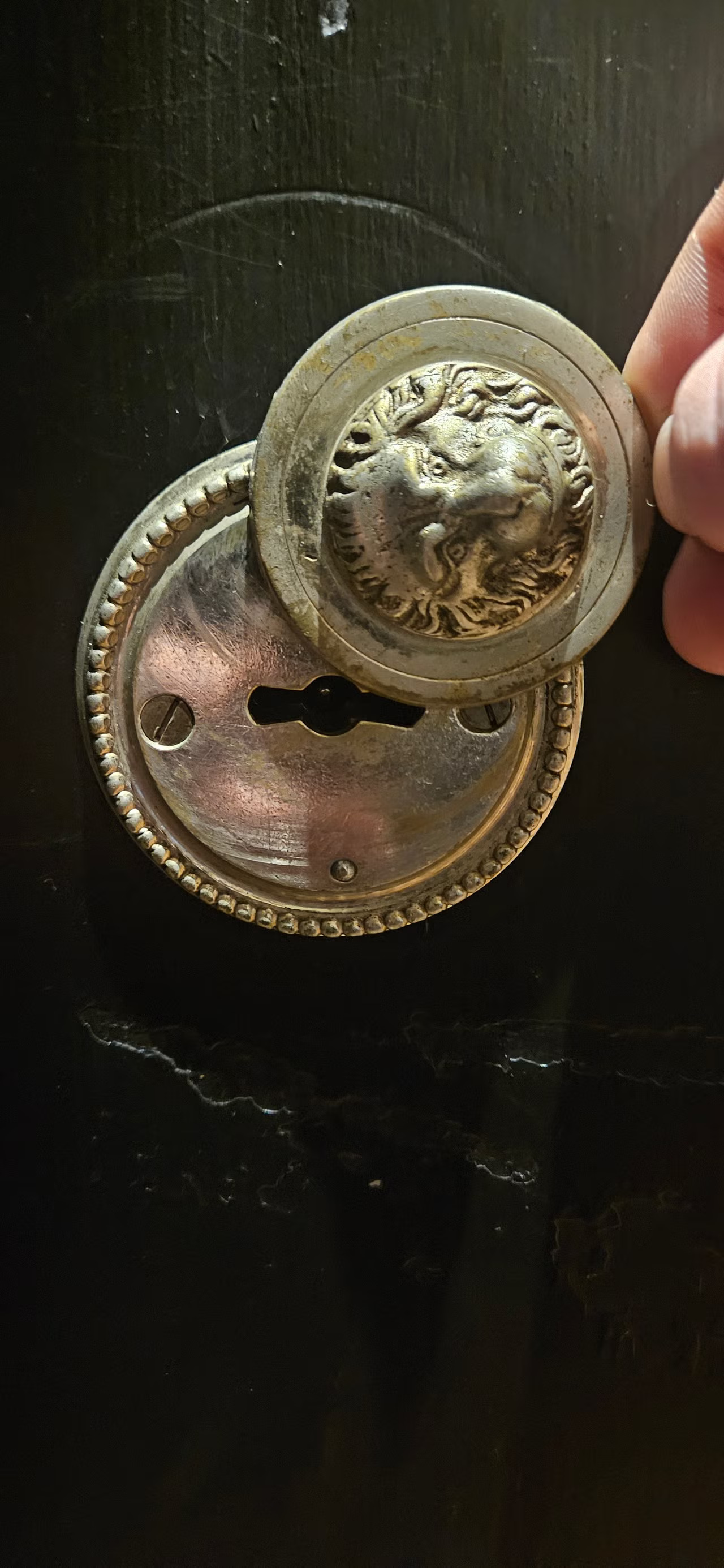 The lion medallion can be moved aside and serves as a decorative cover for the keyhole. Photograph from a sales listing on Blocket.
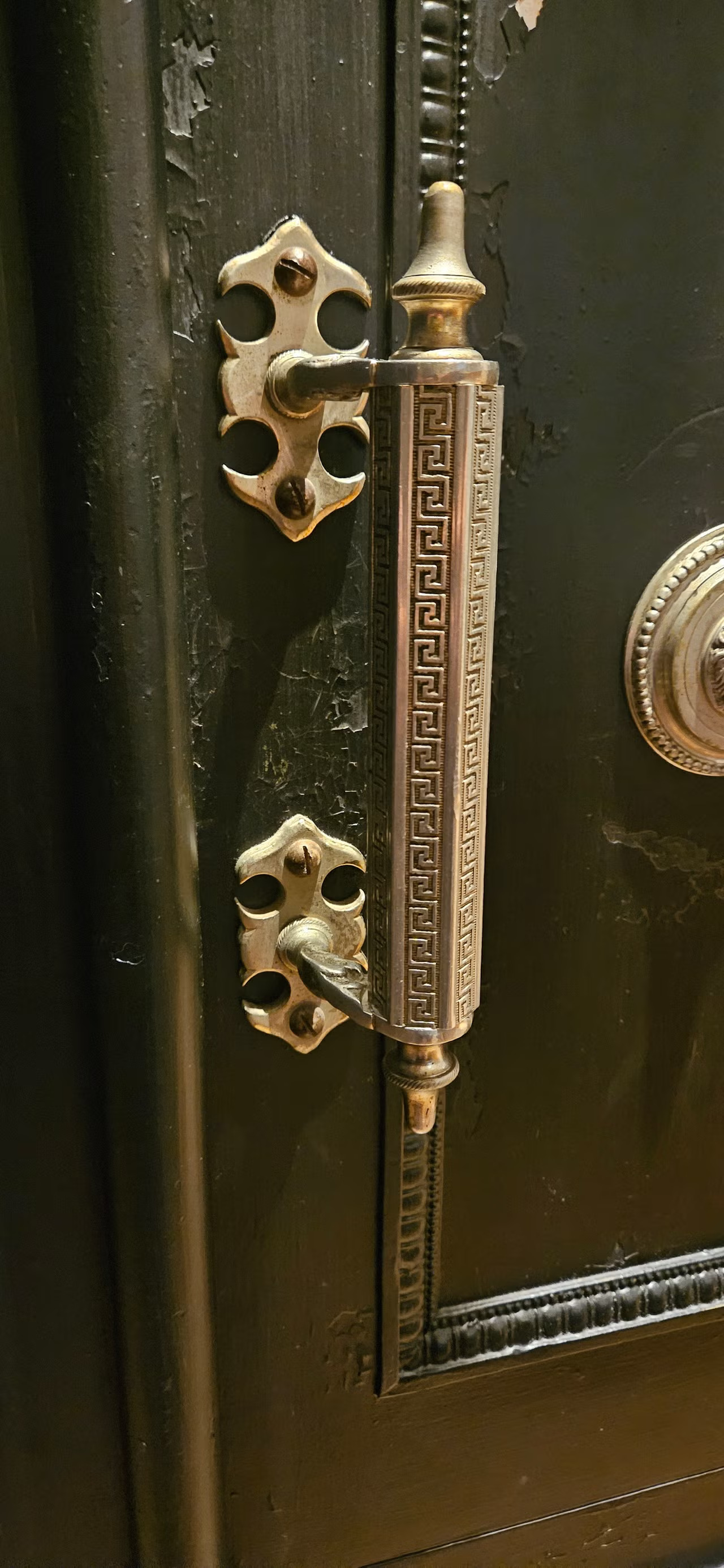 The richly decorated handle is an example of the combination of security engineering and fine furniture craftsmanship. Photograph from a sales listing on Blocket.
Behind the heavy outer door is a separate internal wooden cabinet with its own doors and locks. The combination of multiple layers, separate compartments and decorative joinery makes the surviving example an interesting record of both security technology and Swedish craftsmanship from the nineteenth century.
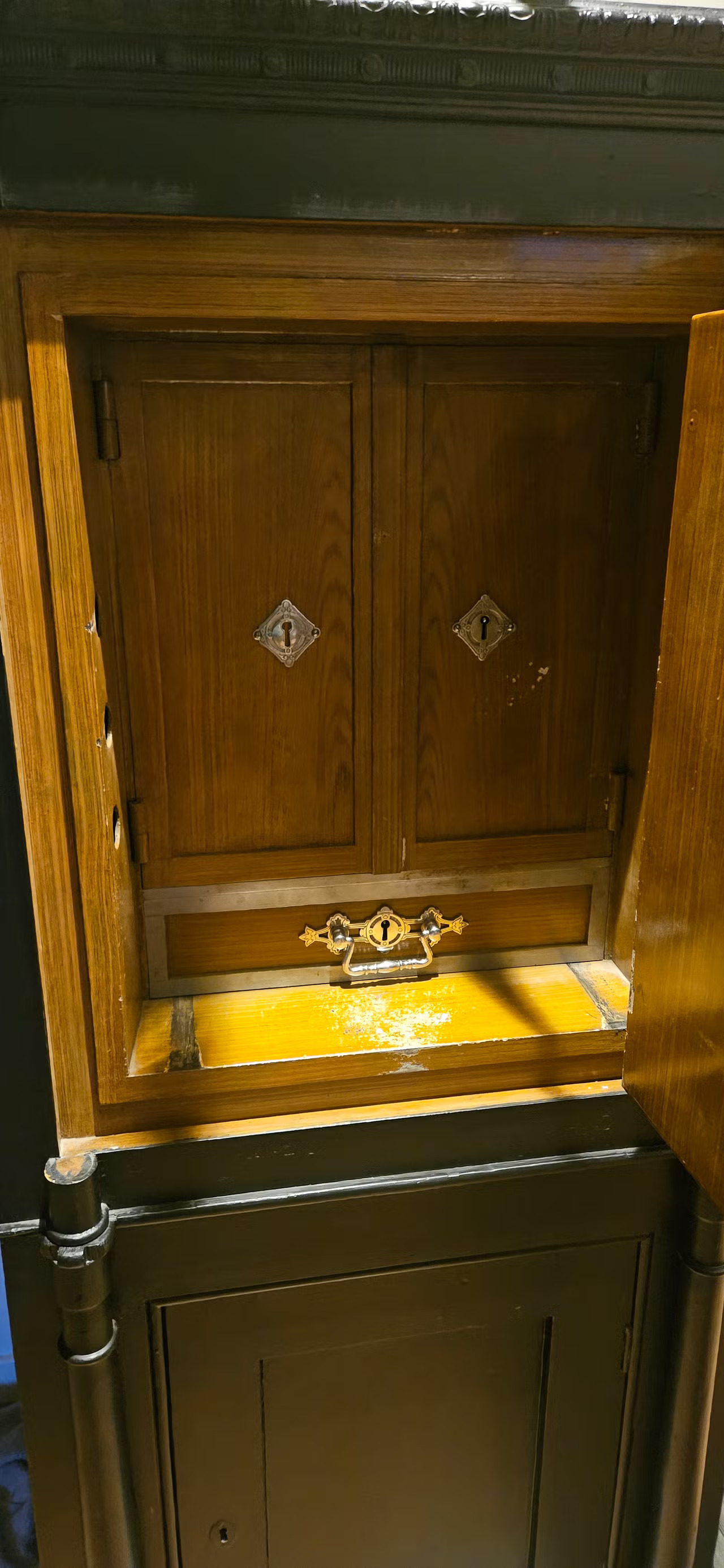 The internal wooden cabinet has separate lockable doors and additional storage compartments. Click the image to open the original in a new tab. Photograph from a sales listing on Blocket.
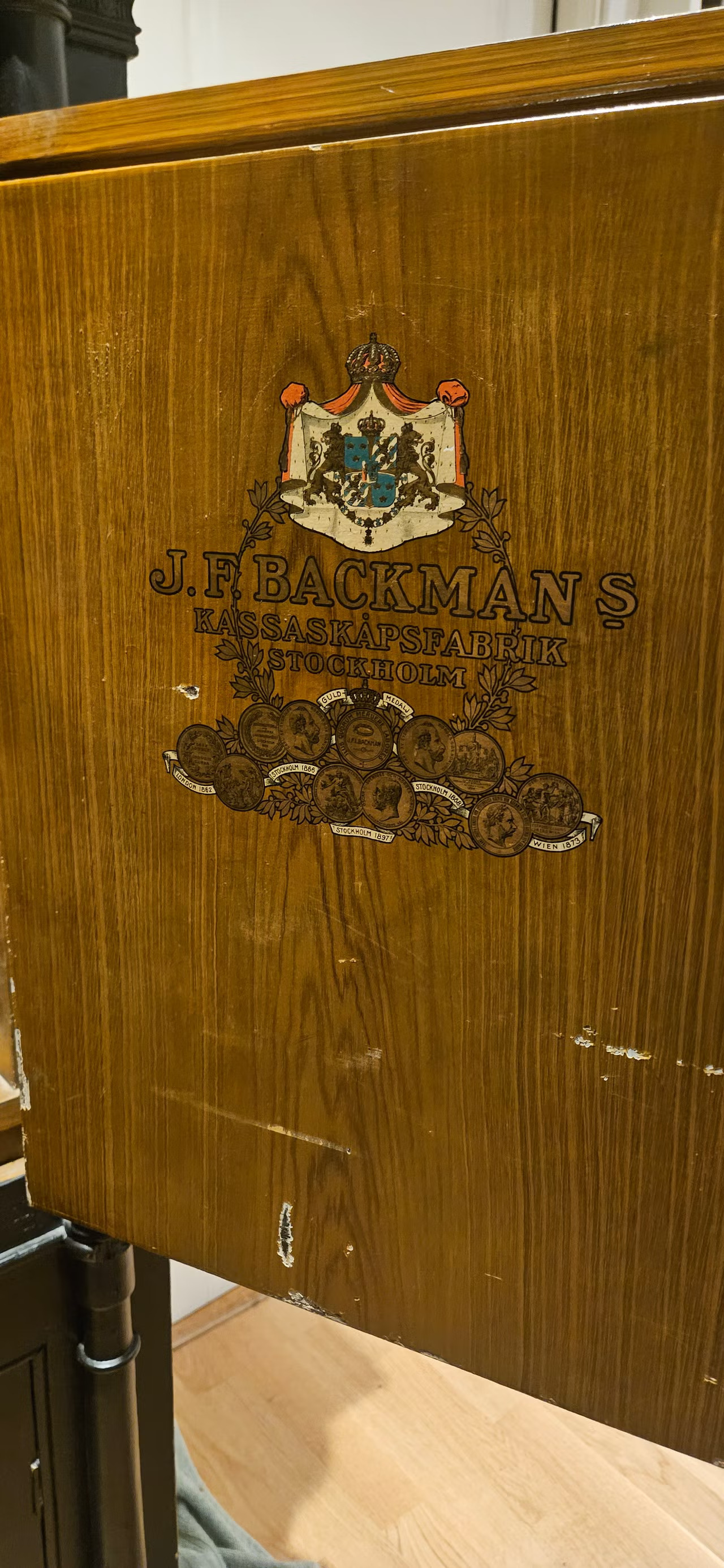 The factory emblem on a surviving Backman safe. Above the company name is the royal coat of arms, while below it is a collection of medals and awards. Photograph from a sales listing on Blocket.
Backman’s final years and his documented legacy
Johan Fredrik Ludvig Backman died in Stockholm on 19 June 1896 at the age of 65. Following his death, an extensive estate inventory was prepared by Stockholm City Court. The documents contain information about his family, assets and items connected with the business.
The estate inventory is valuable because it complements the newspaper reports and the more formal biographical information. Together, these documents make it possible to follow Backman from the young smith who founded a new branch of Swedish industry to the established manufacturer, civic figure and Royal Court supplier of the late nineteenth century.
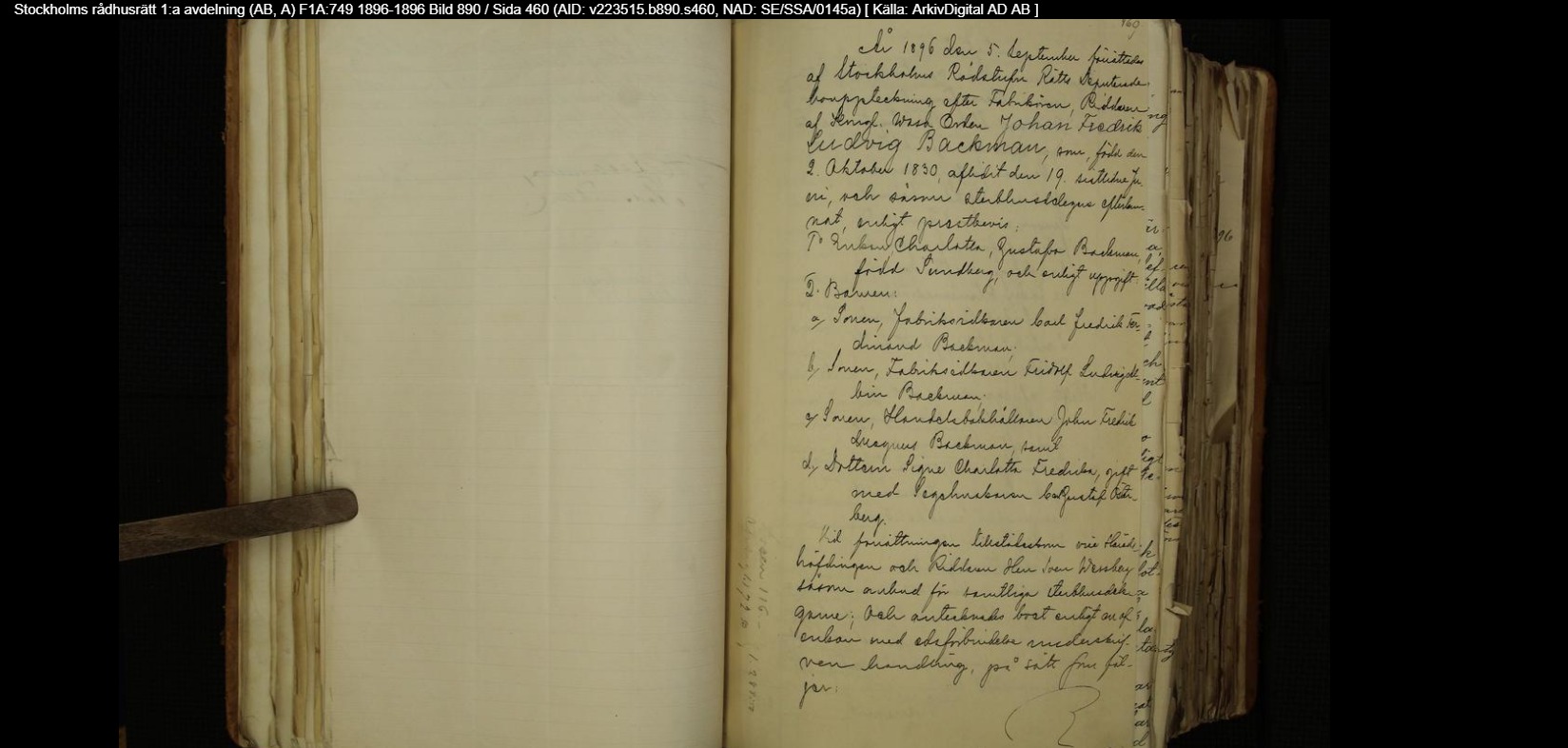 The opening page of the estate inventory of Johan Fredrik Ludvig Backman, Stockholm City Court, 1896. Digital image retrieved via ArkivDigital.
J. F. Backman’s importance to Swedish safe history
Backman’s most important contribution was not one particular technical detail. His significance lies in the combination of industrial manufacturing, technical development, practical testing and public documentation.
When, in 1858, he placed one of his safes in the middle of an extensive wood fire before the public, he effectively took an early step towards the testing culture that would later become central to fire protection and secure storage. The result was not merely to be described by the manufacturer himself. It was to be observed, checked and certified.
Today’s fire-rated document cabinets and safes are tested using entirely different, scientifically standardised methods. There is therefore no modern fire rating that can legitimately be assigned to Backman’s safe of 1858. However, the principle behind his demonstration remains recognisable today, a security claim becomes considerably more meaningful when it can be supported by documented testing.
J. F. Backman was therefore not only the founder of Sweden’s first safe factory. He was also one of the early Swedish manufacturers who helped transform the safe from a simple heavy iron cabinet into a technically developed security product whose resistance could be demonstrated and documented.
About the creation of this article
The historical source material for this article was compiled and processed by Ella Persson. The article was written by Ella Persson with the assistance of ChatGPT, which was used as a tool to help structure the material, formulate the text and bring together information from the various historical sources.
Sources and image material
This article is based on contemporary newspaper material, biographical information, estate inventory records and photographs of a surviving safe manufactured by J. F. Backman’s factory.
Aftonbladet, 1858
All digitised newspaper clippings listed below were retrieved from the National Library of Sweden’s Swedish Newspapers archive.
- Aftonbladet, 26 April 1858, report on "fireproof safes" following the fire in Christiania
- Aftonbladet, 30 April 1858, J. F. Backman’s response and description of the construction of his safes
- Aftonbladet, 20 July 1858, public invitation to the fire test
- Aftonbladet, 22 July 1858, report from the fire test at Ladugårdsgärdet
- Aftonbladet, 24 July 1858, published notarial certificate of the fire test
Portrait and biographical material
The portrait and biographical reference image were retrieved from Svenskt Porträttarkiv, the Swedish Portrait Archive.
Estate inventory, Stockholm City Court, 1896
The digitised images of the estate inventory records were retrieved via ArkivDigital. The original records form part of the archive of Stockholm City Court.
- Stockholm City Court, First Division, 1896, image 890, page 460
- Stockholm City Court, First Division, 1896, image 900
- Stockholm City Court, First Division, 1896, image 910
- Stockholm City Court, First Division, 1896, image 920
J. F. Backman’s Safe Factory and J. Isaksson & Co
Photographs of a surviving J. F. Backman safe
The photographs of the surviving safe were retrieved from a sales listing on Blocket.
Infographic
The Backman family